








For decades, alcohol occupied a strange space in health conversations.
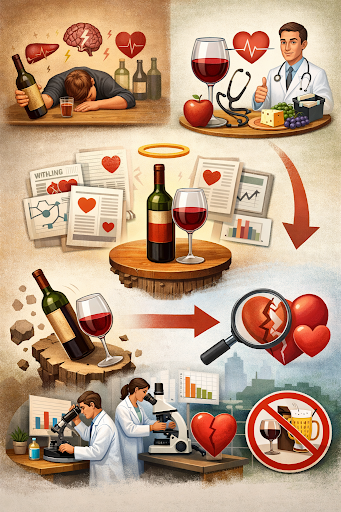
On one hand, heavy drinking was clearly harmful. On the other, moderate drinking—especially red wine—was often portrayed as heart-healthy.
This belief became deeply embedded in public health messaging, media headlines, and even medical discussions. The idea of a daily drink being protective for the heart was repeated so often that it began to sound like established fact.
But as research methods improved and higher-quality data became available, that narrative started to fall apart.
Today, the scientific consensus is shifting in a very different direction.
Where the “Moderate Drinking Is Healthy” Idea Came From
Early studies on alcohol and heart disease were mostly observational. Researchers tracked large groups of people over time and compared health outcomes between drinkers and non-drinkers.
Many of these studies showed a U-shaped or J-shaped curve:
- Heavy drinkers had the highest risk
- Non-drinkers also had elevated risk
- Moderate drinkers appeared to have the lowest risk
At first glance, this suggested that moderate alcohol intake might protect the heart.
But observational studies can only show associations, not causation. Moderate drinkers were often different from non-drinkers in important ways.
They tended to:
- Exercise more
- Eat healthier diets
- Have higher incomes
- Have better access to healthcare
- Smoke less
- Maintain more active social lives
When researchers began adjusting for these factors, the protective effect of alcohol largely disappeared. The advantage was not coming from the alcohol itself. It was coming from healthier lifestyles.
Newer Research: Genetics Changes the Picture
More recent studies have used Mendelian randomization, a method that relies on genetic differences that influence alcohol metabolism.
Because genes are randomly assigned at birth, this approach helps remove lifestyle bias.
These studies consistently show:
- People genetically predisposed to drink less have lower cardiovascular risk
- Risk increases steadily as alcohol intake increases
- There is no clear protective “sweet spot”
When bias is removed, the U-shaped curve becomes more linear. As alcohol intake rises, so does risk.
What Large Population Studies Show
One of the largest analyses on this topic included nearly 600,000 drinkers with more than 5.4 million person-years of follow-up.
Key findings:
- All-cause mortality increased once alcohol intake exceeded 100 grams per week
- Higher intake was linked with:
- Stroke
- Heart failure
- Hypertensive disease
- Aortic aneurysm
- Higher consumption shortened life expectancy by months to years by age 40
More recent research has reinforced these results. Lower intake showed smaller increases in risk, but there was no consistent evidence of benefit.
Alcohol and the Heart
Modern cardiovascular research shows that alcohol affects the heart through several mechanisms.
Blood pressure
Alcohol increases blood pressure through nervous system activation, hormonal changes, and impaired vascular function. Even moderate intake is associated with poorer blood pressure control.
Heart rhythm
Alcohol is one of the most common triggers of atrial fibrillation. The risk rises with each additional daily drink, and reducing intake lowers recurrence rates.
Heart muscle
Long-term alcohol use can weaken the heart muscle, leading to alcoholic cardiomyopathy. Some of this damage may not fully reverse even after stopping alcohol.
Alcohol and the Brain
Recent genetics-based research suggests a linear relationship between alcohol intake and dementia risk. In other words, risk appears to rise as intake increases, with no clearly safe threshold for brain health.
Alcohol can:
- Damage neurons through toxic metabolites
- Increase inflammation
- Shrink memory-related brain regions
- Disrupt white matter integrity
Long-term use is associated with memory problems, executive dysfunction, and higher dementia risk.
Alcohol and Cancer
Alcohol is classified as a Group 1 carcinogen, the same highest-risk category as tobacco and asbestos.
It is linked to cancers of:
- Breast
- Liver
- Esophagus
- Mouth and throat
- Colon and rectum
Risk increases with dose. But importantly, large public health analyses show that a significant proportion of alcohol-related cancers occur in people who drink at light to moderate levels, not just heavy drinkers.
This means the risk does not suddenly appear at high intake. It starts from the first drink and rises gradually.
The WHO Position: No Safe Level
After reviewing the global evidence, the World Health Organization concluded:
- Alcohol is a toxic and dependence-producing substance.
- It causes multiple cancers through biological mechanisms.
- There is no threshold below which cancer risk disappears.
- The more alcohol consumed, the greater the harm.
In simple terms, risk begins from the first drink, and decreases as intake decreases.
Alcohol and Overall Healthspan
Beyond disease risk, alcohol also affects daily function and long-term quality of life.
Research shows alcohol can:
- Reduce muscle protein synthesis
- Impair strength and recovery
- Disrupt sleep
- Worsen metabolic health
Over time, these effects contribute to frailty, loss of independence, and reduced healthspan.
The Practical Reality
The biggest shift in modern research is simple: Alcohol is not medicine. It is not a supplement. And it is not a longevity tool. It is a substance with dose-dependent risks. That does not mean every drink causes immediate harm. But it does mean the old narrative of “a little alcohol is good for you” is no longer supported by current evidence.
REFERENCES:
2-https://pubmed.ncbi.nlm.nih.gov/35843246/#&gid=article-figures&pid=figure-1-uid-0
3-https://methods.sagepub.com/ency/edvol/encyc-of-research-design/chpt/ushaped-curve#_
4-https://jamanetwork.com/journals/jamanetworkopen/fullarticle/2790520?resultClick=3
5- https://www.thelancet.com/journals/eclinm/article/PIIS2589-5370(24)00389-4/fulltext
6-https://www.bmj.com/content/bmj/349/bmj.g4164.full.pdf


