





Most conversations about fat loss start in the middle. Someone tells you to eat less, move more, track calories, cut carbs, or boost metabolism, without first explaining what is actually happening inside the body.
When you start from the basics, fat loss becomes far less mysterious and far more controllable.
At its core, fat loss is not a diet strategy or a workout plan. It is a physiological outcome that occurs when the body is forced to rely on stored energy. Understanding how and why this happens is the difference between chasing short-term results and building something that lasts.
What Your Body Is Doing With Energy Every Day
Every day, your body spends energy just to stay alive. Breathing, circulation, brain activity, temperature regulation — all of this costs calories. This baseline requirement is often called resting or basal energy expenditure.
On top of that, energy is used for movement. Some of this movement is deliberate, like workouts or sports. A much larger portion comes from daily activity — walking, standing, shifting posture, fidgeting, household tasks, commuting. This is where many people unknowingly lose or gain hundreds of calories per day.
Food digestion itself also uses energy, though this is a smaller component.
Add all of these together, and you get your total daily energy expenditure. This number is not fixed. It changes with lifestyle, sleep, stress, training load, and habits.
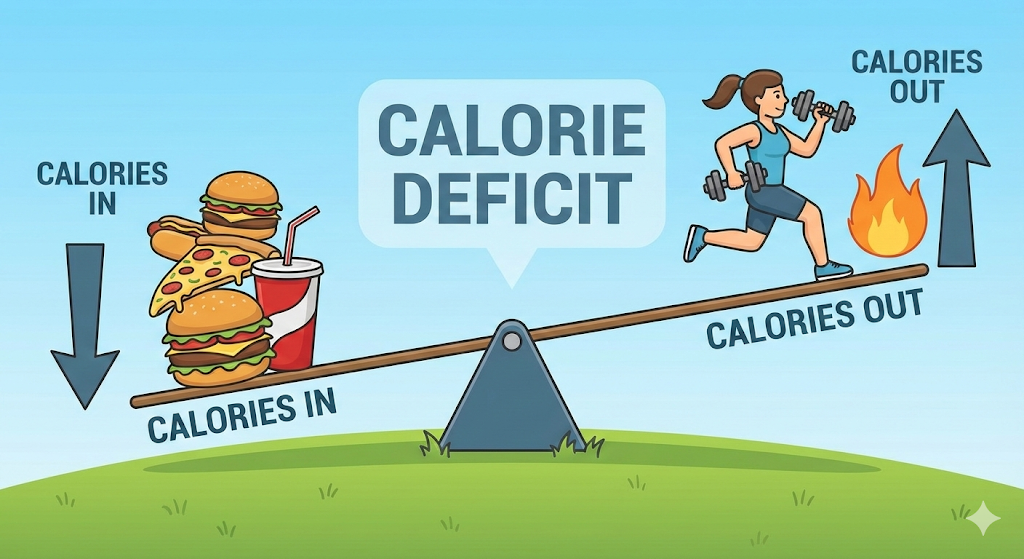
Fat loss happens when energy intake stays below this expenditure for long enough that the body needs to tap into stored fat.
What a Calorie Deficit Really Is (And What It Is Not)
A calorie deficit does not mean starvation. It does not mean feeling miserable or constantly hungry. It simply means that, over time, your body is spending more energy than it is receiving from food.
This gap does not have to be large. In fact, large deficits often backfire. A small, consistent deficit is enough to drive fat loss while preserving muscle, training performance, and mental clarity.
Importantly, a deficit is not created by food alone. It is created by the relationship between intake and output. You can reduce intake, increase output, or — ideally — do a bit of both.
The Three Ways a Calorie Deficit Is Created
There are only three levers you can pull to create a deficit. Everything else is a variation of these.
The first is eating less energy. This can happen intentionally, by portion control or tracking, or unintentionally, through improved food quality and satiety. Protein, fiber, and minimally processed foods tend to reduce hunger naturally, making it easier to eat less without trying to restrict.
The second is moving more. Exercise contributes, but structured workouts are only part of the picture. Daily movement often matters more. People who stay lean long term usually move frequently, even outside the gym.
The third is protecting energy output. This sounds abstract, but it is crucial. Poor sleep, chronic stress, aggressive dieting, and burnout reduce spontaneous movement and training quality. When this happens, the deficit shrinks even if food intake stays the same.
Most failed fat loss attempts ignore this third lever.
Why NEAT Quietly Determines Fat Loss Success
Non-exercise activity thermogenesis — NEAT — refers to all movement that is not formal exercise. This includes walking, standing, changing positions, pacing, cleaning, and general daily activity.
NEAT can vary dramatically between people. Two individuals with identical workouts and diets can differ by several hundred calories per day purely based on daily movement.
As people age, workloads change, or stress increases, NEAT tends to fall. This is one of the biggest reasons people gain weight in their 30s and beyond — not because metabolism suddenly slows, but because life becomes more sedentary.
Preserving an active daily routine often matters more than adding extra cardio sessions.
Exercise Is Not Just About Burning Calories
Exercise helps create a deficit, but its biggest role is preserving muscle and regulating metabolism.
Resistance training signals the body to keep lean tissue even when calories are lower. Without this signal, the body may lose muscle along with fat, which reduces energy expenditure over time.
Cardio increases energy use, improves cardiovascular health, and can support appetite regulation, but it is most effective when it complements strength training and daily activity rather than replacing them.
Exercise also improves insulin sensitivity, sleep quality, and stress tolerance — all of which make maintaining a deficit easier.
Why Nutrition Quality Still Matters in a Deficit
Calories determine whether fat loss occurs. Food quality determines whether the process is sustainable.
Protein supports muscle retention and increases fullness. Fiber slows digestion and reduces hunger. Adequate carbohydrates support training performance. Healthy fats support hormone function and satiety.
Highly processed foods are easy to overconsume because they are energy dense and poorly satiating. A diet built around whole foods makes a calorie deficit feel manageable instead of exhausting.
You can lose fat eating almost anything, but you will not maintain it eating everything.
Why Extreme Dieting Often Fails
Aggressive calorie cuts feel effective initially. Weight drops fast. Motivation spikes. But the body adapts quickly.
Hunger increases. Sleep worsens. Movement subconsciously decreases. Training quality drops. Over time, energy output falls to match intake, and progress stalls.
This is not a lack of willpower. It is a predictable biological response.
Moderate deficits work because they allow the body to keep moving, training, and recovering while still accessing stored fat.
Fat Loss Is a Long Term Energy Management Problem
Fat loss rarely fails because people do not understand calories. Most people know, at least broadly, what they should be doing. Where things usually fall apart is in the way small daily behaviors quietly shape energy balance over time. A missed walk does not feel important. One night of poor sleep seems harmless. A stressful week makes training feel optional. Portions slowly grow without being noticed. Each choice feels insignificant on its own, but together they can completely erase a calorie deficit.
The all or nothing mindset makes this worse. Many people treat fat loss as something that only counts if it is done perfectly. When workouts are missed or food choices are not ideal, the entire effort is mentally written off. One imperfect day turns into several, not because of physiology, but because of psychology. Progress stalls not due to lack of effort, but because consistency was replaced with guilt and overcorrection.
Successful fat loss comes from managing the system rather than chasing perfection. It is about showing up most days, moving your body in small ways, eating reasonably well, and allowing flexibility without abandoning the process. Fat loss rewards steady habits far more than extreme discipline. When energy balance is managed across weeks and months instead of days, progress becomes sustainable and far less stressful
The Takeaway
Fat loss is not about a broken metabolism, hormonal sabotage, or finding the perfect diet. It is about creating a sustainable calorie deficit through a combination of nutrition, movement, training, sleep, and daily activity.
Eat in a way that supports fullness and performance. Train to preserve and build muscle. Move often outside the gym. Sleep enough to protect energy output. Avoid extreme restriction that forces the body into survival mode.
A calorie deficit is not something you force. It is something you build into your lifestyle.That is how fat loss becomes repeatable, predictable, and maintainable — not just possible.
REFERENCE:
https://pubmed.ncbi.nlm.nih.gov/40367516/


