









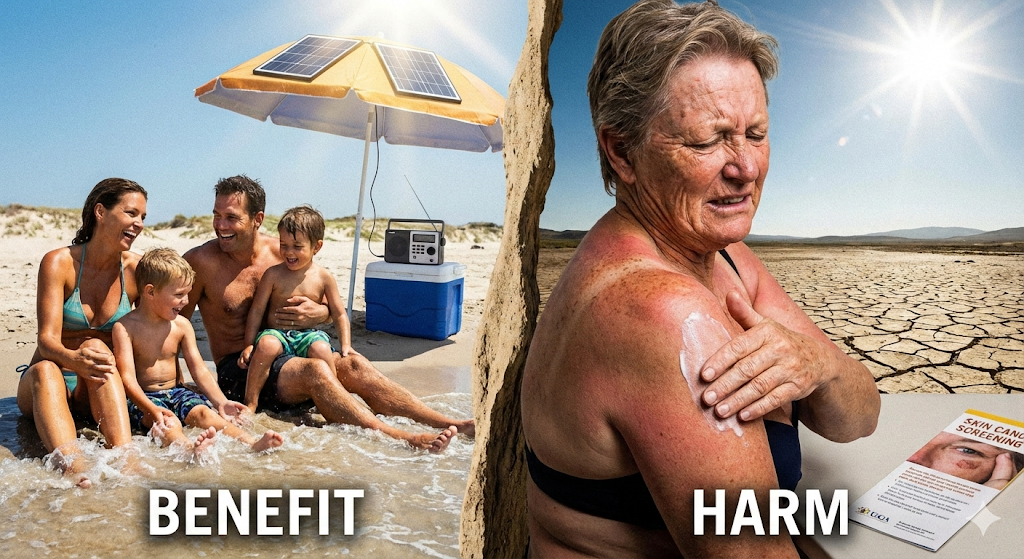
Sunlight has always held a unique place in human health. It represents vitality, outdoor movement, and the natural rhythm of day and night. For decades, both the general public and healthcare professionals have promoted sun exposure as essential for vitamin D synthesis, mental well-being, and overall health. At the same time, dermatologists and public health agencies warn against excessive exposure due to its role in skin aging, eye damage, immune suppression, and skin cancer.
This seeming contradiction has caused a lot of confusion. Should we seek the sun or stay away from it? Does more sunlight always help? Or has risk been exaggerated?
As with most things in health, the truth is in the middle. Sunlight is not purely beneficial or detrimental. The effects depend on the dose, when it is taken, the type of skin, the person’s age, and the situation. We can make smart choices instead of following extreme advice if we understand these subtleties.
This article addresses about how sunlight affects the body, its proven benefits, its often underestimated harms, and how to use this information to improve your health over the long term.
Understanding Sunlight and Ultraviolet Radiation
The sunlight that reaches the Earth comprises visible light, infrared radiation, and ultraviolet (UV) radiation. The UV component is paramount in both health benefits and risks.
Ultraviolet radiation is categorized into three types according to wavelength.
UV-A rays are the predominant type. They infiltrate the skin profoundly and are significantly linked to photoaging and chronic DNA damage.
UV-B rays are less prevalent yet more biologically potent. They induce sunburn and facilitate the synthesis of vitamin D in the skin.
UV-C rays are the most hazardous; however, they are efficiently absorbed by the ozone layer and do not penetrate the Earth’s surface.
Both UV-A and UV-B induce skin damage and carcinogenesis via distinct mechanisms. Significantly, damage from ultraviolet exposure is cumulative, commencing early in life and accumulating over decades.
The Benefits of Sunlight Exposure
Vitamin D Synthesis
The most widely cited benefit of sunlight is vitamin D production. When UV-B radiation strikes the skin, it converts a cholesterol precursor into vitamin D₃, which is later activated by the liver and kidneys.
Vitamin D plays an essential role in calcium absorption, bone mineralization, muscle function, and immune regulation. Deficiency has been linked to rickets in children, osteomalacia in adults, increased fracture risk, and possibly impaired immune function.
However, real-world evidence challenges the assumption that sun exposure alone reliably maintains adequate vitamin D levels. Studies in populations with abundant sunlight, including India, show widespread vitamin D deficiency across all age groups. This suggests that dietary intake, supplementation, skin pigmentation, clothing, pollution, and lifestyle may be more influential than sunlight exposure alone.
In darker-skinned individuals, higher melanin content reduces UV penetration, meaning substantially longer exposure is required to synthesize the same amount of vitamin D as lighter-skinned individuals. This often pushes exposure into ranges where skin damage risk increases.
Psychological Well-Being and Circadian Health
Sunlight plays a crucial role in regulating circadian rhythms. Exposure to natural light during the day helps synchronize the internal body clock, improving sleep quality, hormonal regulation, and daytime alertness.
Sunlight exposure has also been associated with improved mood and reduced symptoms of seasonal affective disorder. Bright light influences serotonin signaling and helps reinforce the natural sleep–wake cycle, indirectly supporting mental health and cognitive function.
These benefits, however, are primarily linked to daylight exposure, not prolonged or intense UV exposure. Being outdoors, walking, and engaging in physical activity during daylight hours may confer many of these advantages without requiring excessive sun exposure.
Therapeutic Uses in Dermatology
Controlled UV exposure has therapeutic applications in certain skin conditions. Phototherapy is used under medical supervision to treat psoriasis, vitiligo, and some inflammatory skin disorders.
These treatments are carefully dosed, monitored, and targeted. They should not be confused with unregulated sun exposure, which lacks precision and increases the risk of unintended harm.
The Harms of Excessive Sun Exposure
Skin Aging and DNA Damage
Chronic UV exposure accelerates skin aging, leading to wrinkles, loss of elasticity, uneven pigmentation, and rough texture. UV-A radiation penetrates deep into the dermis, damaging collagen and elastin fibers over time.
At the cellular level, UV radiation causes direct DNA damage and generates reactive oxygen species. These changes accumulate silently for years before becoming clinically visible.
Skin Cancer Risk
Sun exposure is one of the strongest environmental risk factors for both melanoma and non-melanoma skin cancers. Importantly, exposure during childhood and adolescence appears to carry a disproportionate long-term risk.
Early UV exposure can damage melanocyte DNA, increasing the likelihood of malignant transformation later in life. While individuals with darker skin have a lower overall risk due to melanin’s protective effects, the risk is not zero, and severe sunburns can still cause significant damage.
Immune Suppression and Autoimmune Effects
UV radiation has immunosuppressive effects on the skin. It alters antigen presentation, suppresses local immune responses, and increases the production of immunomodulatory cytokines.
In susceptible individuals, UV exposure can exacerbate autoimmune conditions such as lupus. It may also reduce the skin’s ability to respond to infections and repair damage effectively.
Eye Damage
Prolonged sun exposure increases the risk of cataracts, retinal damage, and other ocular conditions. UV radiation can penetrate ocular tissues, especially at high altitudes or during air travel, where UV intensity is higher.
Unlike skin damage, eye damage is often painless and unnoticed until significant impairment occurs.
Sun Exposure in Children: A Special Consideration
Children are uniquely vulnerable to the harmful effects of UV radiation. Their skin is thinner, DNA repair mechanisms are still developing, and cumulative lifetime exposure begins early.
Despite common practices encouraging sunlight exposure in infants for perceived health benefits, pediatric guidelines strongly advise protecting infants—especially those under six months—from direct sun exposure. Vitamin D requirements should be met through diet and supplementation rather than intentional sun exposure.
Importantly, evidence shows that even with regular sun exposure, many infants and children remain vitamin D insufficient, reinforcing the need for nutritional strategies rather than reliance on sunlight alone
How Much Sun Is Enough?
There is no universal prescription for “safe” sun exposure. The amount required for vitamin D synthesis varies widely based on skin type, latitude, season, time of day, clothing, and environmental factors.
For individuals with darker skin, the duration required to synthesize meaningful amounts of vitamin D may be several times longer than for fair-skinned individuals. This often overlaps with exposure levels associated with increased skin damage.
This uncertainty is why many professional bodies no longer recommend deliberate sun exposure as a primary strategy for maintaining vitamin D sufficiency. Diet and supplementation provide a more reliable and safer alternative.
Practical Guidelines for Balanced Sun Exposure
The goal is not sun avoidance but sun intelligence.
Short, incidental sun exposure during daily activities is generally sufficient for circadian regulation and psychological benefits. Outdoor physical activity in the early morning or late afternoon minimizes UV intensity while retaining daylight benefits.
During peak UV hours, typically between late morning and mid-afternoon, protective strategies become essential. These include seeking shade, wearing protective clothing, wide-brimmed hats, sunglasses, and using sunscreen on exposed skin when necessary.
Sunscreen should be viewed as a supportive tool, not a license for prolonged sun exposure. Clothing and timing remain the most effective protective measures.
Rethinking Vitamin D: Sunlight Is Not the Only Answer
One of the most important takeaways from current evidence is that vitamin D deficiency is often a dietary problem, not a sunlight problem. Even in sun-rich environments, deficiency remains common.
Relying on sun exposure alone to correct deficiency is unreliable and may increase long-term health risks. A balanced approach that includes dietary sources, fortified foods, and supplementation when necessary provides better control without exposing individuals to unnecessary UV damage.
The Bottom Line
Sunlight is a powerful biological signal with both benefits and risks. It supports circadian rhythms, mental well-being, and vitamin D synthesis, yet excessive or unprotected exposure contributes to premature aging, immune disruption, eye damage, and skin cancer.
The modern challenge is not choosing between sun exposure and sun avoidance, but learning how to dose sunlight intelligently. Context matters. Age matters. Skin type matters. And long-term health should always outweigh short-term assumptions.
The healthiest relationship with sunlight is one grounded in moderation, evidence, and respect for individual differences. Sunlight is not medicine to be taken freely, nor a toxin to be feared completely. It is a powerful environmental factor that demands understanding and balance.
REFERENCES:
1- https://pmc.ncbi.nlm.nih.gov/articles/PMC7001416/
2-https://pubmed.ncbi.nlm.nih.gov/27645314/
3-https://pubmed.ncbi.nlm.nih.gov/35371396/
4-https://onlinelibrary.wiley.com/doi/full/10.1111/jdv.17660
6-https://www.mdpi.com/2076-3417/14/11/4339


