








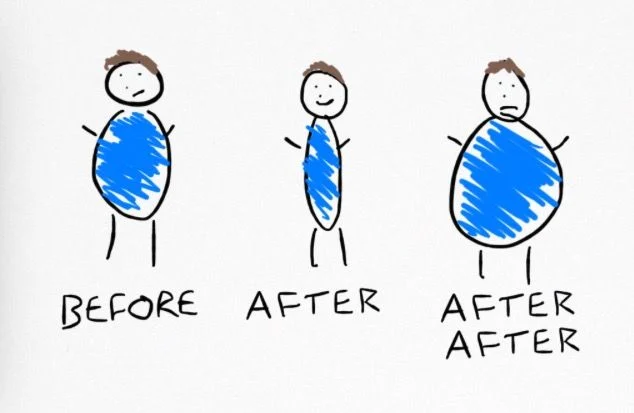
Losing weight is difficult. Keeping it off is often harder.Most people who have successfully dieted recognize this pattern. Weight comes down with structure, discipline, and sustained effort. For a period of time, things feel stable and under control. Then, slowly and almost unnoticed, the weight begins to return. Not overnight. Not dramatically. Just enough to feel frustrating and confusing.
The data reflect this reality. Up to 35% of weight lost during an intervention is typically regained within one year, and by five years, most people regain all or a majority of the weight they initially lost.
This cycle is remarkably consistent across populations. It affects celebrities, athletes, and everyday individuals alike. Even those with access to elite trainers, nutritionists, and highly structured programs are not exempt.
That alone tells us something important.Weight regain is not primarily a failure of motivation or discipline. It is a predictable biological and behavioral response.
Weight Loss Changes the Rules of Energy Balance
Body weight is governed by energy balance: the relationship between calories consumed and calories expended. When intake exceeds expenditure, weight increases. When expenditure exceeds intake, weight decreases.
What is rarely explained is that the body does not treat weight loss as a neutral event.
From a biological perspective, sustained weight loss signals risk. In response, the body activates compensatory mechanisms designed to restore energy balance and protect survival. These mechanisms do not switch off when the diet ends.
As a result, after weight loss, the same calorie intake that once maintained body weight may now lead to gradual regain.
Not because something broke but because physiology adapted.
The Three Components of Daily Energy Expenditure
Daily energy expenditure is made up of three major components.
Resting energy expenditure represents the calories required to sustain basic life functions such as breathing, circulation, and organ activity. It contributes the largest share of total daily energy burn for most individuals.
Activity energy expenditure includes all movement-related calorie burn. This includes formal exercise, but more importantly, it includes spontaneous daily movement such as walking, posture maintenance, and fidgeting.
The thermic effect of feeding represents the calories burned during digestion and nutrient processing. This component is relatively stable and plays a smaller role in long-term weight regulation.
After weight loss, all three can change — but not equally.
Metabolic Adaptation Is Real, But It’s Not the Main Culprit
Resting metabolic rate does decline after weight loss, even when body size and composition are controlled. This phenomenon, known as adaptive thermogenesis, reflects improved metabolic efficiency.
Long-term human studies show reductions in resting energy expenditure of roughly 70 to 150 calories per day in individuals who have lost and maintained weight.
This slowdown is real.
But it is not large enough to fully explain why regain happens so easily.
The larger shift occurs elsewhere.
NEAT: The Hidden Driver of Weight Regain
The most significant drop in energy expenditure after weight loss comes from non-exercise activity thermogenesis.
After weight loss, people unconsciously move less. Steps decrease. Fidgeting reduces. Movements become more energy efficient. The same actions burn fewer calories than before.
This happens without awareness.
Metabolic ward studies show that individuals maintaining a reduced body weight can expend hundreds of calories per day less through activity than predicted. In many cases, the reduction in activity energy expenditure exceeds 300 to 500 calories per day.
This is not about skipping workouts. Exercise is a conscious decision. NEAT is regulated automatically by the nervous system and energy availability.
As weight decreases, spontaneous movement decreases and efficiency increases. This is a survival adaptation — but in a modern environment, it strongly favors regain.
Fat Cells Don’t Disappear — They Remember
When weight is lost, fat cells do not disappear. They shrink.
Recent human evidence shows that fat tissue retains a long-lasting biological memory of a person’s highest body weight. Even after weight loss, gene expression inside fat cells continues to resemble a previously heavier state.
These shrunken fat cells behave like empty storage units. They remain biologically active and primed to refill.
When weight is lost rapidly, these cells send distress signals to the brain indicating low energy availability. Hunger increases. Cravings intensify. Food becomes more rewarding.
This is not loss of control.
It is a coordinated survival response.
Leptin Drops, Appetite Rises
As fat mass decreases, leptin levels fall. Leptin signals energy sufficiency to the brain. When it drops, the brain interprets the situation as energy depletion.
The result is increased hunger, reduced satiety, and a parallel decrease in energy expenditure.
Crucially, these changes persist even after active dieting ends. Appetite does not simply normalize once weight loss stops.
This creates a narrow margin for maintenance: lower energy burn combined with higher biological drive to eat.
Why Weight Rebound Is So Common After Dieting Ends
This is where many weight loss attempts quietly fail.
Any active dieting phase that ends without deliberate lifestyle modification is likely to end in long-term failure — not because the person lacked discipline, but because the system supporting the weight loss was removed.
During a diet, structure artificially controls intake and activity. When that structure disappears, biology reasserts itself. Hunger remains elevated. NEAT remains suppressed. Energy efficiency remains high.
If nothing replaces the diet with sustainable habits, weight regain becomes the default outcome.
This is why weight rebound is not random.
It is the predictable consequence of ending a fat loss phase without a maintenance strategy.
High Activity Levels Protect Against Regain
The most consistent protective factor against weight regain is high daily activity.
Long-term registries of successful weight loss maintainers show that individuals who sustain higher activity levels are far more likely to keep weight off. Importantly, this activity is not limited to structured exercise.
NEAT plays a dominant role.
Walking more, standing more, accumulating movement across the day, and designing environments that encourage activity help restore energy expenditure toward pre-diet levels.
Because NEAT declines unconsciously after weight loss, maintaining it requires conscious design.
Weight Regain Is a Systems Problem, Not a Moral One
Weight rebound is not evidence of weak willpower or poor discipline.
It is the predictable outcome of biological adaptations interacting with an environment that makes overeating easy and movement optional.
Long-term success does not come from trying harder.
It comes from understanding the system and working with it.
Weight loss changes the rules.
Maintenance requires learning the new ones.
The Bottom Line
Weight regain is often driven by a phenomenon known as collateral fattening, which stems from the loss of lean mass during the fat-loss process. When weight loss is pursued with overly aggressive calorie deficits, insufficient protein intake, and little or no resistance training, the body sheds muscle alongside fat. This creates a metabolic environment that favors fat regain once dieting pressure eases.
After weight loss, the body does not simply return to baseline. It becomes more energy-efficient, less spontaneously active, and more driven to eat. While resting metabolism may slow slightly, the dominant forces behind rebound weight gain are reductions in daily movement and persistent increases in hunger. Together, these adaptations can reduce total daily energy expenditure by hundreds of calories, even when formal dieting has stopped.
Compounding this biology are behavioral factors. Diets that clash with personal preferences, social contexts, schedules, or real-world environments are rarely sustainable. Similarly, the absence of a structured physical activity or resistance-training program almost guarantees regain, both by accelerating lean mass loss and by reducing the body’s capacity to expend energy.
Weight regain, then, is not a failure of motivation or discipline. It is a predictable outcome when biological adaptations and unsustainable strategies collide. It is also not inevitable. But preventing it requires a deliberate maintenance plan that prioritizes lean mass retention, adequate protein, resistance training, and dietary approaches that can adapt across environments and phases of life.
Sustainable fat loss is not about winning the diet phase.
It is about mastering what comes after.
And that begins with understanding biology
REFERENCES:
https://pubmed.ncbi.nlm.nih.gov/8034818/
https://pmc.ncbi.nlm.nih.gov/articles/PMC8370708/
.


