





In today’s fitness culture, gym-goers and athletes are constantly pushed to train harder, lift heavier, and do more sessions each week. Social media glorifies intensity, soreness, and exhaustion, often presenting them as signs of progress. However, what is rarely discussed with the same seriousness is recovery—the phase where actual adaptation and performance improvement occur.
Many people face common problems: persistent muscle soreness, plateaued strength, declining performance, poor sleep, frequent injuries, and burnout. These issues are often blamed on “bad genetics” or “lack of discipline,” when in reality, they are usually the result of inadequate or mismanaged recovery.
Recovery is not about laziness or taking time off—it is a physiological requirement. Without proper recovery, training stress accumulates faster than the body can adapt, increasing the risk of injury, hormonal disruption, and long-term performance decline.
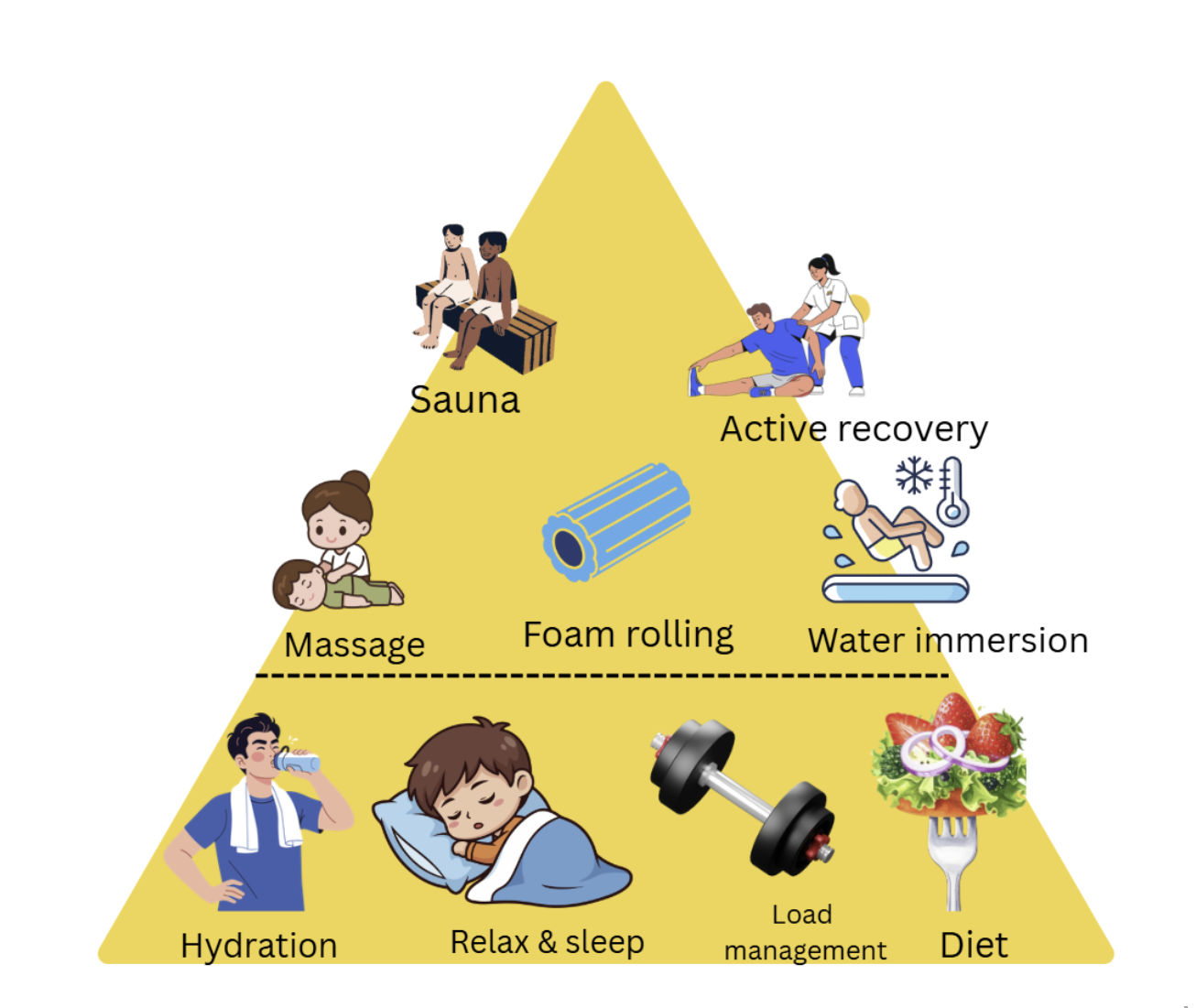
This article is important because recovery is often misunderstood, overcomplicated, or marketed through expensive gadgets and hacks. To bring clarity, we will break recovery into Tier 1 (non-negotiable fundamentals) and Tier 2 (supportive but secondary tools). This structure helps gym-goers and athletes prioritize what actually matters before chasing advanced or trendy methods.
TIER 1 (The foundation)
1) Sleep
Sleep extension and improved sleep quality consistently improve physical and cognitive performance in athletes; interventions that increase nightly sleep or add naps produce measurable gains in reaction time, sprint performance, and skill retention. Systematic reviews report benefits from sleep extension protocols, although evidence quality is mixed and trial sizes are often small. Prioritize 7–9 hours of consolidated sleep nightly and consider brief naps (20–90 min) on heavy days.
Actionable tips: keep a consistent sleep schedule, control light/blue-light before bed, and use naps strategically after very late or long sessions.
2) Energy availability & total calories
Low energy availability (LEA) / Relative Energy Deficiency in Sport (RED-S) is linked to reduced performance, impaired recovery, hormonal disruption, and higher injury risk. Systematic reviews show that chronic calorie deficits in athletes hurt training adaptations and raise health risks. For athletes (especially endurance, weight-category, or aesthetic sports), avoid prolonged large deficits—use periodized calorie plans and monitor symptoms of LEA (persistent fatigue, poor recovery, menstrual disturbance, recurrent illness).
Actionable tip: during high-volume phases aim for maintenance or slight surplus; plan controlled deficits only when performance demands allow and with professional supervision.
3) Protein intake
Multiple meta-analyses show that protein intake strongly influences gains in lean mass and strength when combined with resistance training. Benefit plateaus around ~1.6 g/kg/day, with meaningful gains up to about 2.2 g/kg/day for some athletes and in energy-restricted states; supplemental protein adds less benefit once total daily intake is already close to that range. Distribute protein across the day (≈20–40 g per meal) to maximize muscle protein synthesis.
Practical guideline: aim for 1.6–2.0 g/kg/day (higher end during calorie restriction or very high training loads); split across 3–5 protein-containing meals.
4) Training-load management
Longitudinal monitoring of external and internal load (volume, intensity, session RPE, HRV, wellness scores) is strongly associated with injury risk and recovery status. Systematic reviews show consistent links between sudden spikes in load and increased injury/illness; planned load progression and scheduled deloads reduce risk and improve long-term adaptation. Treat soreness and persistent performance drop-offs as signals to reduce load, not badges of honor.
Simple rules: avoid sudden >10–20% weekly spikes in volume/intensity, include regular lower-intensity or recovery weeks, and use auto-regulation when fatigue is high.
5) Psychological stress & recovery
High life stress reduces physiological recovery capacity and increases injury/illness susceptibility. Systematic reviews and RCT meta-analyses of stress-regulation interventions (mental skills training, CBT, relaxation) show meaningful reductions in anxiety and improvements in recovery markers and performance when psychological skills are trained. Address sleep, workload, and life stress together—mental recovery strategies are not optional for competitive athletes.
Practical tools: daily brief breathing/relaxation, routine scheduling to lower life-stress spikes, and short sessions of psychological skills training for teams/individuals.
TIER 2 (Additional tools)
1) Cold Water Immersion (Ice Baths)
Ice baths can reduce muscle soreness, help you feel more recovered between hard or closely spaced sessions, reduce perceived fatigue, and improve recovery of muscle strength and power 24-48 hours post exercise. However, using them regularly after strength training may slow long-term muscle growth. Best used during competitions or very high training loads.
2) Compression Garments
Compression clothing may slightly reduce muscle soreness and feelings of fatigue, but improvements in strength, sprinting, or power are inconsistent. Useful for comfort and travel, not a replacement for sleep or nutrition.
3) Massage & Foam Rolling
Massage and foam rolling can reduce delayed muscle soreness and temporarily improve flexibility. Their effects on restoring strength or power are minimal, so they work best for symptom relief rather than speeding up true recovery.
4) Stretching
Stretching improves flexibility and joint range of motion but does not meaningfully reduce muscle soreness or speed up strength recovery. Useful for mobility goals, not a primary recovery method.
5) Recovery Gadgets (Normatec, Percussion Guns, Cryotherapy Chambers)
These tools can improve comfort and the feeling of recovery, but objective improvements in performance or muscle repair are limited. Think of them as convenience tools, not necessities.
6) Sauna / Heat Exposure
Sauna use can support relaxation, lower blood pressure, and improve perceived recovery, and when used strategically, it may enhance endurance performance. Although heat exposure does not directly speed up muscle repair, it can aid stress reduction, improve sleep quality, and increase overall training tolerance, making it a useful supportive recovery tool once the fundamentals are in place.
An important limitation of studies are usually absence of proper placebo controls. Rather than using a sham heat intervention to account for expectancy effects, most studies simply compare sauna exposure to a control group that does nothing, which may overestimate the true effect size.
REFERENCES
1-https://pubmed.ncbi.nlm.nih.gov/37462808/
2-https://pmc.ncbi.nlm.nih.gov/articles/PMC9724109/
3-https://pubmed.ncbi.nlm.nih.gov/28698222/
4-https://pubmed.ncbi.nlm.nih.gov/27677917/
5-https://www.tandfonline.com/doi/full/10.1080/1750984X.2021.1977974
6-https://link.springer.com/article/10.1186/s40798-024-00724-6
7-https://pubmed.ncbi.nlm.nih.gov/36862831/
8-https://onlinelibrary.wiley.com/doi/10.1002/ejsc.12074
9-https://pubmed.ncbi.nlm.nih.gov/37270272/
10-https://pmc.ncbi.nlm.nih.gov/articles/PMC10532323/
11-https://pmc.ncbi.nlm.nih.gov/articles/PMC12305623/
12-https://pmc.ncbi.nlm.nih.gov/articles/PMC12286022/
13-https://pmc.ncbi.nlm.nih.gov/articles/PMC4306786/#sec1-5


