









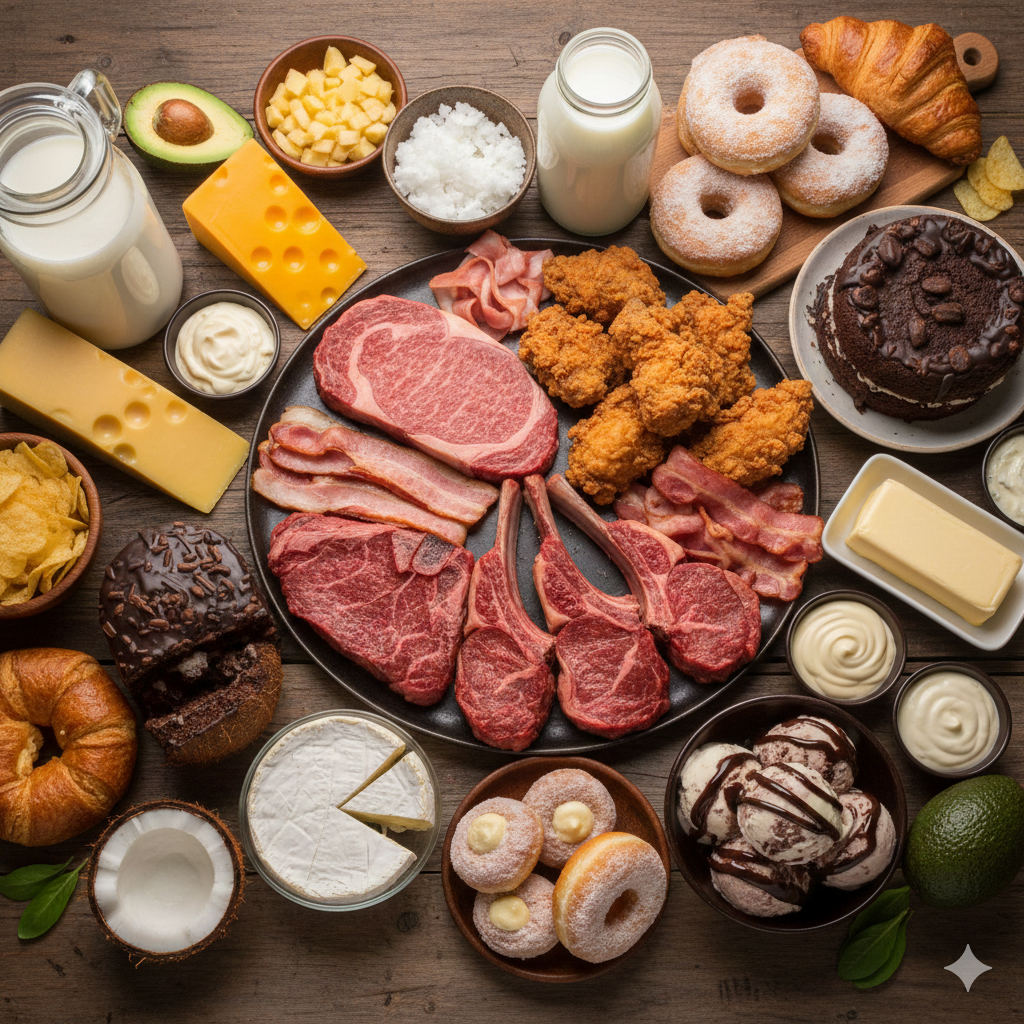
Saturated fat has lived many lives in the world of nutrition. At one time, it was treated as the main culprit behind heart disease. Then came the backlash. Suddenly, saturated fat was being defended as harmless, even healthy. Social media turned it into a symbol of rebellion against old dietary guidelines. Butter in coffee, ghee is heart healthy, coconut oil in everything, and slogans like “fat doesn’t make you fat” became part of mainstream conversation.
But nutrition rarely works in extremes. Most of the time, the truth sits somewhere in the middle.
To understand saturated fat, you have to step away from the headlines and look at how the body actually responds to it, and more importantly, what replaces it in the diet.
Nothing in Nutrition Exists in Isolation
One of the most important ideas in nutrition science is this: every food choice is a trade-off.
When you eat more of one thing, you automatically eat less of something else. If you add more fat to your diet, you are probably eating fewer carbohydrates. If you reduce saturated fat, something has to replace those calories.
That replacement is what determines whether a dietary change helps or harms your health.
This is where much of the confusion around saturated fat comes from. Different studies compare different diets. Some replace saturated fat with refined sugar. Others replace it with nuts, seeds, or plant oils. Naturally, the outcomes look very different.
So the real question is not just, “Is saturated fat good or bad?”
The better question is, “Compared to what?” or “what is the safe dosage”.
What Saturated Fat Actually Is
Saturated fat is a type of fat found mostly in animal products and a few plant sources. Common examples include:
- Butter and ghee
- Cheese and cream
- Fatty cuts of meat
- Processed meats
- Coconut oil and palm oil
The term “saturated” refers to the chemical structure of the fat. But what matters from a health perspective is how these fats behave inside the body.
And the most consistent effect seen across decades of research is their impact on LDL cholesterol.
The LDL Cholesterol Connection
LDL cholesterol is often called “bad” cholesterol, though the reality is more nuanced. LDL itself is not evil. It is simply a particle that transports cholesterol through the bloodstream.
The issue arises when LDL levels remain elevated over long periods. Higher lifelong exposure to LDL is strongly linked to the buildup of plaque in the arteries. Over time, this process increases the risk of heart attacks and strokes.
Across controlled feeding studies, saturated fat consistently raises LDL cholesterol when compared to unsaturated fats. This has been shown again and again in metabolic ward experiments, where diets are tightly controlled.
This is one of the main reasons saturated fat became a focus of public health recommendations in the first place.
What We Learned from Whole Populations
Large population studies also offer important clues.
In the mid-20th century, some countries consumed diets extremely high in saturated fat, sometimes over 20 percent of total daily calories. These same populations often had very high rates of heart disease.
When dietary patterns changed and saturated fat intake fell, cardiovascular mortality declined.
Finland is one of the clearest examples. In the 1970s, it had some of the highest heart disease rates in the world. A nationwide campaign encouraged people to reduce butter consumption and shift toward plant oils and other foods.
Over the following decades:
- Average cholesterol levels dropped
- Saturated fat intake declined
- Heart disease deaths fell by nearly 80 percent
A large portion of this improvement was linked to reductions in blood cholesterol driven by changes in dietary fat.
The Replacement Principle
Modern nutrition science has moved away from asking whether saturated fat is harmful in isolation. Instead, researchers study what happens when saturated fat is replaced with other nutrients.
And this is where the data becomes very clear.
When about 5 percent of total calories from saturated fat is replaced with polyunsaturated fats, heart disease risk drops by roughly 10 to 25 percent. In some large cohort analyses, mortality from heart disease fell by around 25 percent with this same substitution.
Controlled feeding trials show similar patterns. Replacing 5 percent of calories from saturated fat with polyunsaturated fats lowers LDL cholesterol by about 10 milligrams per deciliter, a change associated with meaningful reductions in cardiovascular risk. Across multiple randomized trials, this type of substitution has been linked to roughly a 27 percent reduction in cardiovascular events.
A similar pattern appears when saturated fat is replaced with plant-based monounsaturated fats. In large population studies, replacing 5 percent of calories from saturated fat with these fats reduced heart disease risk by about 19 to 24 percent.
This is reflected in dietary patterns like the Mediterranean diet. In the PREDIMED trial, participants who added either four tablespoons of olive oil per day or about 30 grams of mixed nuts to their diets experienced around a 30 percent reduction in major cardiovascular events over five years, despite no intentional calorie restriction.
What About Carbohydrates?
The picture becomes more complicated when saturated fat is replaced with carbohydrates.
If saturated fat is replaced with refined carbohydrates and added sugars, the benefit largely disappears. In some studies, there is no improvement in cardiovascular risk at all.
But when saturated fat is replaced with high-quality carbohydrates like whole grains, the results are different. In large cohort analyses, replacing 5 percent of calories from saturated fat with whole grain carbohydrates reduced heart disease risk by about 23 percent.
In contrast, replacing saturated fat with high-glycemic refined carbohydrates increased heart attack risk by around 33 percent in some analyses.
This explains why some research appears to show no association between saturated fat and heart disease. In those cases, saturated fat was simply replaced with foods that were equally harmful
Evidence from Controlled Trials
Randomized controlled trials provide some of the strongest evidence in nutrition.
Across multiple trials, replacing saturated fat with polyunsaturated fat has been shown to:
- Lower LDL cholesterol
- Improve overall lipid profiles
- Reduce cardiovascular events
Some meta-analyses report reductions in heart disease risk exceeding 20 percent when this substitution is made.
When different types of studies point in the same direction, the overall conclusion becomes much stronger.
Do All Saturated Fat Foods Act the Same?
Not exactly.
Different foods contain different combinations of nutrients, which can influence health outcomes.
For example:
- Processed meats are consistently linked with higher disease risk.
- Dairy foods often show neutral or slightly protective associations in some studies.
- Coconut oil raises LDL cholesterol in controlled trials, similar to butter.
These differences highlight an important shift in nutrition science. Researchers now focus more on overall dietary patterns and food quality rather than single nutrients in isolation.
What Most Health Guidelines Recommend
Despite changing trends in nutrition culture, most major health organizations still recommend limiting saturated fat intake.
Typical guidance includes:
- Keeping saturated fat below about 10 percent of total daily calories
- Prioritizing unsaturated fats from plant oils, nuts, seeds, and fish
- Building meals around whole, minimally processed foods
These recommendations are based on decades of evidence from clinical trials, population studies, and metabolic research.
What a Heart-Supportive Diet Actually Looks Like
The diets most consistently linked to long-term health share a few common features.
They tend to:
- Emphasize unsaturated fats from plant sources and fish
- Include plenty of whole grains and legumes
- Contain a wide variety of fruits and vegetables
- Limit processed meats and high saturated fat foods
Mediterranean-style diets are one of the best known examples. These eating patterns are repeatedly associated with lower rates of heart disease.
Key Takeaways
Saturated fat has a consistent effect in controlled research. When compared to unsaturated fats, it tends to raise LDL cholesterol, which is one of the strongest predictors of cardiovascular disease.
Long-term exposure to elevated LDL levels is strongly associated with higher heart disease risk. This relationship is not based on a single study or theory. It is supported by decades of genetic research, epidemiology, and randomized controlled trials.
However, the effect of saturated fat is not absolute. It is contextual. What matters most is what replaces it in the diet.
When saturated fat is replaced with polyunsaturated fats, cardiovascular risk falls significantly. When it is replaced with refined carbohydrates and added sugars, the benefit is minimal or sometimes nonexistent.
Because of this, most global nutrition guidelines recommend keeping saturated fat intake at or below about ten percent of total daily calories. This threshold is not arbitrary. It reflects levels at which population risk for cardiovascular disease tends to be lower.
But that ten percent figure is meant as a broad public health guideline, not a precise personal prescription.
A More Practical Way to Apply This
In real life, the goal is not to obsess over a single percentage. The goal is to maintain blood markers that reflect low long-term cardiovascular risk.
Instead of treating ten percent as a strict ceiling, it is more practical to treat it as a reference point. From there, your actual intake should be guided by how your body responds.
Key markers to monitor include:
- LDL cholesterol
- ApoB, which is an even stronger predictor of cardiovascular risk
- Triglycerides
- HDL cholesterol
- Non-HDL cholesterol
If these markers remain within optimal ranges, your current intake of saturated fat is likely appropriate for your physiology. If they begin to rise, it may be a sign that your intake is too high for your individual response.
This matters because people do not respond to saturated fat in the same way. Some individuals experience only small changes in LDL. Others see large increases from the same intake. Genetics, activity levels, body composition, and overall diet quality all influence this response.
So while general guidelines suggest keeping saturated fat around ten percent of calories, the more intelligent long-term strategy is to find a level where your key health markers remain in optimal ranges.
Saturated fat is not a dietary villain. But it is also not something to ignore. Its effects depend on the bigger picture of your diet and your body’s biological feedback over time.
When you focus on patterns, balance, and measurable health markers, the role of saturated fat becomes much easier to manage.
REFERENCES:
1-https://pmc.ncbi.nlm.nih.gov/articles/PMC4095759/
2-https://www.ahajournals.org/doi/10.1161/cir.0000000000000510
3-https://pubmed.ncbi.nlm.nih.gov/19959603/


