






A Window Into Stress, Recovery, and Long-Term Health
In recent years, heart rate variability, commonly referred to as HRV, has gained attention far beyond elite sports and clinical research. Once confined to cardiology labs and performance physiology, HRV is now visible on consumer wearables, often reduced to a single number presented each morning. Despite this growing popularity, HRV remains widely misunderstood.
At its core, HRV is not a fitness score, a stress badge, or a marker to compete over. It is a physiological signal that reflects how well the body adapts to the demands placed upon it. When interpreted correctly, HRV provides useful information about recovery capacity, nervous system balance, and long-term health resilience.
What HRV Actually Measures
Heart rate variability refers to the natural variation in time between consecutive heartbeats. While heart rate measures how many times the heart beats per minute, HRV focuses on the subtle fluctuations in the intervals between those beats. In a healthy system, these intervals are constantly changing by milliseconds.
This variability is not a flaw in the system. It is a feature of a responsive and adaptable cardiovascular and nervous system. A heart that beats with perfectly uniform timing is often under rigid autonomic control and may reflect physiological strain rather than efficiency.
Higher HRV generally indicates that the body can respond to stressors and then return to a state of recovery efficiently. Lower HRV often reflects prolonged stress, inadequate recovery, illness, or metabolic strain.
The Autonomic Nervous System and HRV
HRV is governed by the autonomic nervous system, which regulates involuntary functions such as heart rate, blood pressure, digestion, and respiration. This system consists of two primary branches that operate in constant balance.
The sympathetic nervous system prepares the body for action. It increases heart rate, elevates blood pressure, and mobilizes energy during exercise, psychological stress, or perceived threats. The parasympathetic nervous system supports recovery. It slows heart rate, promotes digestion, tissue repair, and energy conservation.
Healthy physiology depends not on dominance of one system over the o
ther, but on the ability to transition smoothly between them. HRV reflects this flexibility. A higher HRV suggests that the parasympathetic system can effectively counterbalance sympathetic activation after stress. A chronically low HRV suggests that the body remains trapped in a heightened state of arousal with limited recovery.
Why Chronically Low HRV Matters
Short-term reductions in HRV are normal and expected. Hard training sessions, poor sleep, emotional stress, or acute illness will temporarily suppress HRV. In these cases, HRV often rebounds once the stressor is removed and recovery occurs.
The concern arises when HRV remains persistently low over weeks or months. Chronic suppression of HRV has been associated with increased cardiovascular risk, impaired metabolic health, reduced stress tolerance, and higher all-cause mortality. For this reason, HRV is increasingly studied as a predictive marker of long-term health and longevity rather than a simple performance metric.
Low HRV reflects a system that is under continuous strain. It does not identify a specific disease, but it signals that the body’s ability to adapt is compromised.
Exercise as a Stressor That Improves HRV
Exercise is one of the most effective ways to improve HRV, but only when applied with appropriate volume, intensity, and recovery. During exercise, sympathetic nervous system activity rises sharply. Heart rate increases, variability decreases, and stress hormones are released. This acute stress is necessary to trigger adaptation.
Following exercise, the parasympathetic system becomes more active, promoting recovery and restoration. Over time, repeated exposure to this stress-recovery cycle improves autonomic efficiency, leading to higher baseline HRV.
Aerobic exercise, in particular, has consistently been shown to improve HRV by enhancing cardiac efficiency and vagal tone. However, excessive training without adequate recovery can produce the opposite effect. Chronic overreaching or under-recovery suppresses HRV, signaling that training stress has exceeded adaptive capacity.
HRV does not indicate whether exercise is good or bad. It reflects whether exercise is appropriately dosed relative to recovery.
Strength Training, Intensity, and Nervous System Load
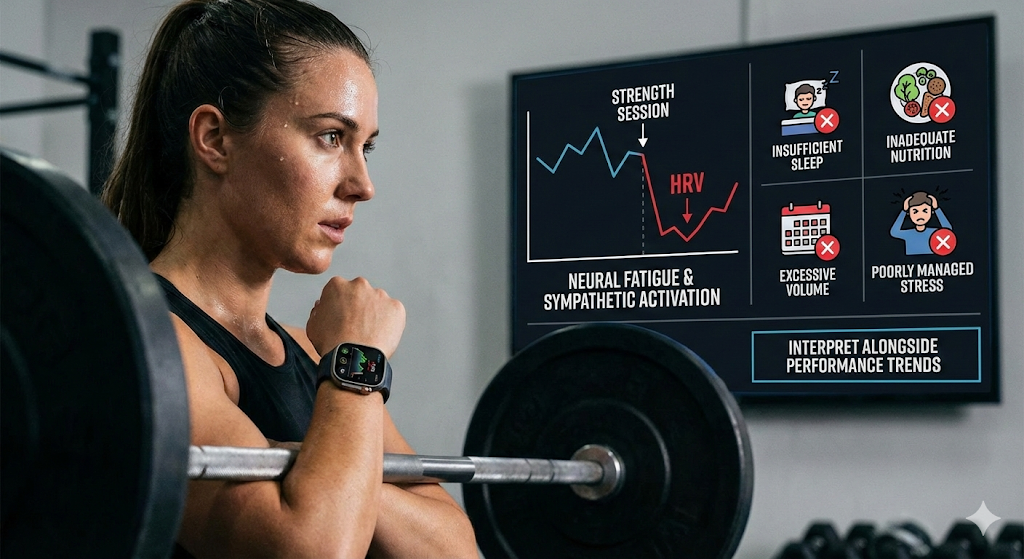
Resistance training influences HRV differently from endurance exercise. Heavy loads, high intensity, and large training volumes place substantial demands on the nervous system. As a result, HRV may drop significantly in the days following intense strength sessions.
This response is not pathological. It reflects neural fatigue and sympathetic activation. Problems arise only when HRV fails to recover over time, suggesting insufficient sleep, inadequate nutrition, excessive volume, or poorly managed stress outside of training.
For strength-focused individuals, HRV is most useful when interpreted alongside performance trends, mood, and recovery markers rather than as a daily readiness score.
Nutrition, Energy Availability, and HRV
Energy intake plays a central role in autonomic regulation. When calorie intake is insufficient relative to training and lifestyle demands, the body perceives this as a chronic stressor. Prolonged low energy availability increases cortisol levels, suppresses parasympathetic activity, and reduces HRV.
This pattern is frequently observed during aggressive fat loss phases, particularly when combined with high training volumes. Fat loss itself is not inherently harmful, but sustained energy deficiency compromises recovery and autonomic balance.
The principle that applies here is simple and universal: the dose makes the poison. Exercise improves health until recovery is inadequate. Calorie restriction improves body composition until it impairs physiological regulation. HRV often reflects this imbalance before overt symptoms emerge.
Alcohol
Alcohol consumption has been shown to reduce Heart Rate Variability (HRV), a response likely driven by sympathetic nervous system activation or the inhibition of parasympathetic activity. This effect was substantiated by a study involving 542 healthy individuals categorized by their alcohol intake. Notably, the data indicated that high alcohol consumption correlates with both lowered HRV and elevated cortisol levels, suggesting that the hypothalamo-hypophyseal-adrenal (HPA) axis may play a significant role in this physiological response
Sleep, Lifestyle Stress, and Daily HRV Fluctuations
Sleep quality and duration are among the strongest predictors of HRV. Poor sleep consistently reduces parasympathetic activity and lowers next-day HRV. Alcohol consumption, late caffeine intake, irregular sleep schedules, and excessive screen exposure before bedtime all negatively influence HRV.
When HRV remains suppressed, the most effective interventions are often basic rather than complex. Improving sleep consistency, increasing energy intake, reducing training volume, and managing psychological stress frequently restore HRV more effectively than supplements or biohacks.
Interpreting HRV From Wearable Devices
The rise of wearable devices has made heart rate variability accessible outside of laboratories, but accessibility does not automatically translate into correct interpretation. HRV is a highly sensitive physiological signal that fluctuates across the day and responds to multiple internal and external factors. For this reason, its true value lies not in isolated readings but in patterns observed over time.
Modern wearables estimate HRV by analyzing the variation between successive heartbeats, typically during sleep when the body is in a relatively stable state. This controlled measurement window reduces noise caused by movement, posture, and acute emotional stress. While the exact algorithms differ between devices, most rely on time-domain measures such as RMSSD, which reflect parasympathetic nervous system activity.
One of the most important principles when working with HRV data is individualization. HRV values vary widely between people due to age, genetics, training history, and biological sex. A value that is considered low for one individual may be completely normal for another. For this reason, cross-person comparisons are rarely meaningful and often misleading.
Instead, HRV should be interpreted relative to a personal baseline. Changes within an individual provide far more useful information than absolute numbers. A gradual upward trend over weeks or months often reflects improved recovery capacity, better sleep quality, or more appropriate training load. Conversely, a sustained downward trend may signal accumulating fatigue, insufficient recovery, illness, psychological stress, or inadequate nutrition.
Daily fluctuations are expected and should not be overinterpreted. HRV is responsive to hydration status, sleep timing, alcohol intake, emotional stress, and recent exercise. Short-term dips are part of normal physiology. What matters is whether the system returns to baseline or continues to drift downward under persistent stress.
When viewed this way, wearable-derived HRV is not a score of fitness or discipline. It is a feedback tool that reflects how the autonomic nervous system is coping with the total stress load imposed by training, lifestyle, and environment. Used thoughtfully, it can guide smarter decisions around recovery, training intensity, and long-term health without becoming a source of unnecessary anxiety
What HRV Ultimately Teaches Us
HRV reinforces a fundamental principle of health and performance: stress is unavoidable, but recovery determines outcomes. Training, work, emotional challenges, and lifestyle demands all impose stress on the body. None are inherently harmful. Problems arise when stress accumulates faster than recovery.
HRV does not moralize behavior or dictate rigid rules. It simply reflects how well the body is adapting to its environment. When used thoughtfully, it can guide more sustainable approaches to training, nutrition, and long-term health.
HRV is not a number to chase. It is feedback to respect.
REFERENCES:
https://link.springer.com/article/10.1007/s12559-023-10200-0
https://pubmed.ncbi.nlm.nih.gov/21134026/
https://pubmed.ncbi.nlm.nih.gov/8941112/
https://pubmed.ncbi.nlm.nih.gov/10982537/
https://pubmed.ncbi.nlm.nih.gov/23683953/
https://pubmed.ncbi.nlm.nih.gov/23370966/
Improvements in heart rate variability with exercise therapy – PMC
The Association of Sleep Duration and Quality with Heart Rate Variability and Blood Pressure – PMC


