






Introduction
Most people jump straight into fat loss or muscle gain without ever understanding the baseline they are working from. Calories get cut. Training volume goes up. Progress is expected to happen automatically. When it does not, frustration follows.
Knowing your maintenance calories is what turns nutrition from guesswork into a system. Maintenance is the reference point that tells you whether you are truly in a deficit, genuinely in a surplus, or simply hovering in place while effort feels high and results feel absent. Without this anchor, stalls are often blamed on slow metabolism, poor genetics, or lack of discipline, when in reality intake is closer to maintenance than assumed.
Maintenance calories also explain why small dietary changes sometimes work and sometimes do nothing. They clarify why weight can remain stable despite eating “more,” or why aggressive restriction feels exhausting but barely moves the scale. Once maintenance is understood, fat loss becomes a controlled deviation from baseline rather than a constant fight against the body.
Many people assume maintenance calories are a fixed target—a number you calculate once, lock in, and build everything around. Eat above it and you gain weight. Eat below it and you lose weight.
In real life, it does not work that cleanly.
What Maintenance Calories Actually Mean
Maintenance calories represent the amount of energy required to keep body weight stable on average, over time. They reflect the point where energy intake and energy expenditure roughly balance.
However, that balance is dynamic. Energy needs fluctuate day to day based on sleep, stress, digestion, movement, training, and even posture. The body absorbs these fluctuations through small adjustments in energy output, particularly via non-exercise movement and metabolic efficiency.
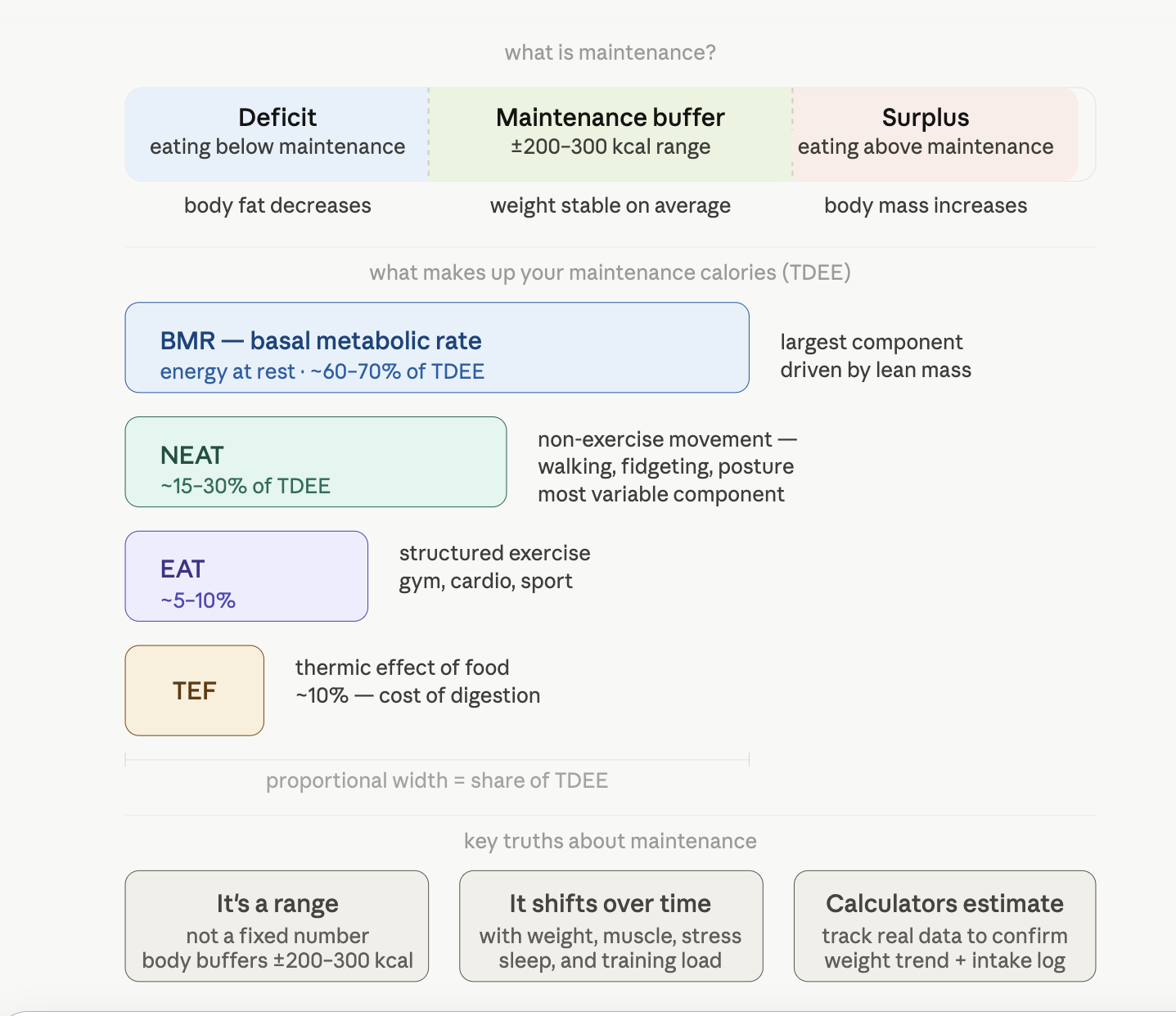
Because of this adaptability, maintenance calories exist within a buffering zone, typically around two to three hundred calories. Within this range, the body can often compensate without meaningful weight change. This is why cutting sixty calories or adding one hundred calories rarely moves the scale.
How to Find Maintenance Calories
Maintenance calories refer to the amount of energy needed each day to keep body weight stable over time. While often described as the point where calories consumed equal calories expended, this balance exists as a range rather than a single fixed number. Activity level, body composition, and adaptive responses all influence where maintenance sits.
A common starting point is to use standardized equations or online calculators. These typically multiply body weight by a fixed value and apply an activity multiplier. For example, body weight in kilograms multiplied by roughly twenty-two calories provides a baseline estimate, which is then adjusted based on activity level. This approach is fast and practical, especially for beginners, but it only provides an estimate, not a definitive answer.
The limitation of calculators is that they cannot account for individual differences in metabolism, organ mass, muscle mass, or daily movement patterns. Comparisons between predicted and measured energy expenditure show errors of several hundred calories in either direction. This explains why people of similar height and weight can maintain body weight on very different calorie intakes. For this reason, calculators should be treated as a starting hypothesis, not a final prescription.
A more accurate approach involves tracking real-world data. This means logging calorie intake and body weight consistently for at least two weeks. Average intake is then compared with the average weight trend. If body weight remains stable, that intake is close to true maintenance. If weight changes, calories can be adjusted accordingly.
To refine this further, changes in body weight can be translated into energy balance using the approximate rule that one kilogram of weight change reflects roughly seven to seventy-seven hundred calories over time. For example, losing 0.2 kilograms per week while eating 3,300 calories suggests a small deficit, meaning true maintenance is likely slightly higher. Adjusting intake based on observed trends allows maintenance to be dialed in with much greater precision.
The most reliable method combines both approaches: use equations for an initial estimate, then validate and refine that estimate through consistent tracking. Maintenance calories are not static and will shift with changes in training, lifestyle, stress, and body composition. Regular monitoring is what turns an estimate into an individualized, evidence-based number.
The Maintenance Buffering Zone
The buffering zone is the range in which the body absorbs small calorie changes by adjusting energy expenditure rather than body weight.
If calories drop slightly, the body may reduce spontaneous movement, lower muscular efficiency, or subtly decrease resting energy expenditure. If calories increase slightly, non-exercise activity and thermogenesis may rise instead.
This buffering is largely driven by two components. Basal metabolic rate, which reflects the energy needed to maintain essential physiological functions at rest, and non-exercise activity thermogenesis, which includes unconscious movement such as fidgeting, posture shifts, walking pace, and daily activity outside structured exercise.
Together, these systems allow the body to maintain stability in the face of small energy changes. To produce consistent weight gain or loss, intake must move outside this buffering zone.
Why Small Calorie Changes Often Do Nothing
Many people attempt fat loss by making very small calorie cuts. In theory, this should lead to slow weight loss over time. In practice, it often leads to frustration.
When calorie changes remain within the buffering zone, the body compensates. Energy expenditure quietly adjusts downward. Movement becomes more efficient. Daily steps may decline without conscious awareness. Over time, the intended deficit disappears, even though intake appears lower on paper.
This same mechanism explains why reverse dieting can work. Calories can increase gradually without weight gain because energy expenditure rises to match intake.
Why Maintenance Calories Change Over Time
Maintenance calories are not permanent. As body weight changes, maintenance shifts. A lighter body requires fewer calories to maintain, while a heavier body requires more. Muscle mass, training volume, stress levels, sleep quality, and daily activity all influence where maintenance sits.
Even at the same body weight, maintenance can drift due to behavioral and physiological adaptations. This is why relying on a calculator alone is rarely sufficient over the long term.
Why Maintenance Should Be Treated as a Range
Once maintenance is identified, it should not be treated as a rigid number. Because energy expenditure fluctuates daily, maintenance works best as a range rather than a single intake target.
Staying within this range allows flexibility without triggering unwanted weight gain or loss. It also reduces anxiety around food and tracking. Small deviations do not automatically matter. Long-term averages do.
What This Means in Practice
To lose fat, intake must fall outside the maintenance buffering zone, not just slightly below a calculator estimate.
To gain muscle efficiently, intake must rise beyond the buffering range, not hover near it.
To maintain weight long term, consistency matters more than precision.
The body is not fragile. It is adaptive.
The Takeaway
Maintenance calories are not a single number you discover once and never revisit. They are a moving range shaped by physiology, behavior, and adaptation.
Stop chasing perfect precision.Start working with trends, averages, and biological reality.
That is where sustainable progress actually comes from.
REFERENCES:
https://pmc.ncbi.nlm.nih.gov/articles/PMC3673773/
https://pmc.ncbi.nlm.nih.gov/articles/PMC6392078/


