







Introduction
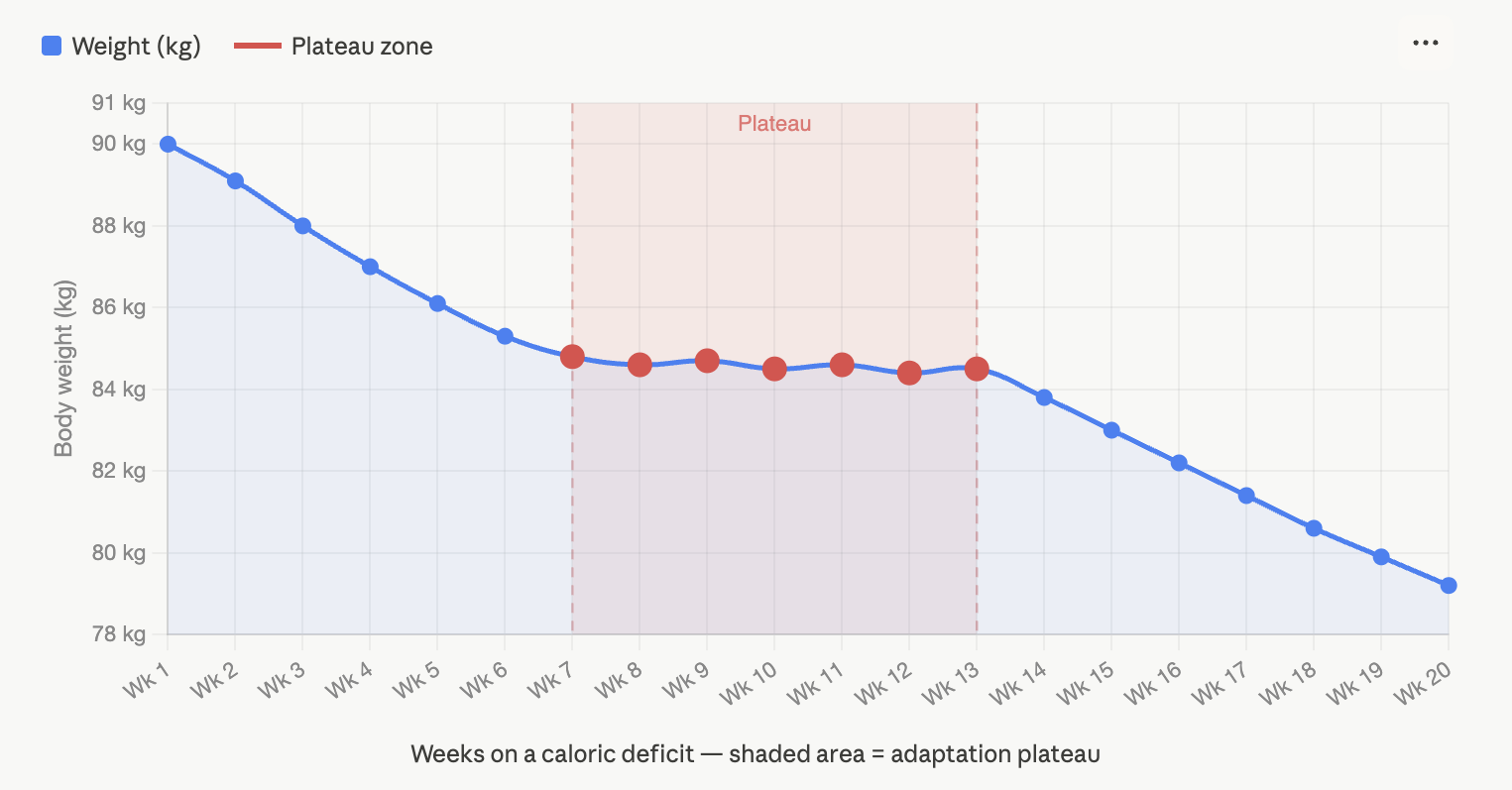
Weight loss plateaus are one of the most frustrating phases of a fat loss journey. You start strong. The scale moves consistently for a few months. Clothes fit better. Motivation is high. Then one day, progress simply stops. Calories are still being tracked, workouts are still happening, and habits appear unchanged. This stall is often blamed on a damaged or slow metabolism, but the reality is far more nuanced and far more human.
From an evolutionary perspective, the human body is not designed for prolonged calorie restriction. It is designed to survive scarcity. When body weight begins to drop, the brain interprets this change as a potential threat to survival. In response, it activates a series of compensatory adaptations aimed at conserving energy and restoring balance. These changes are not signs of dysfunction. They are protective mechanisms that once helped humans survive famine.
Understanding these adaptations is the key to understanding why plateaus happen and, more importantly, how to move past them.
- The First Adaptation Happens in Your Behavior, Not Your Metabolism
One of the earliest and most underestimated reasons fat loss slows is behavioral rather than metabolic. As body weight decreases, people often begin to move less without conscious awareness.
Daily steps decline. Spontaneous movements like fidgeting reduce. Posture becomes more efficient. Time spent sitting increases slightly. Even transitions between activities become slower. Collectively, these subtle changes reduce non exercise activity thermogenesis, or NEAT, which plays a major role in total daily energy expenditure.
What makes this particularly challenging is that structured workouts often remain unchanged. You may still be training four or five days per week, yet your overall daily energy output quietly drops because everything outside the gym becomes more energy efficient. Over time, this reduction can meaningfully erase the calorie deficit that once drove fat loss.
- Metabolic Adaptation
Alongside behavioral changes, metabolic adaptations do occur. As body mass decreases, resting metabolic rate naturally declines because a lighter body requires fewer calories to maintain essential physiological functions. On average, each pound of weight loss may reduce resting metabolic rate by approximately seven calories per day.
For most individuals, this reduction is modest and often overstated online. However, when weight loss is substantial or aggressive, these small changes can accumulate. Importantly, this reflects improved metabolic efficiency rather than metabolic damage. Your body is simply learning how to do more with less.
The magnitude of metabolic adaptation becomes more visible in cases of extreme weight loss. Long term follow up data from contestants on The Biggest Loser demonstrated that participants experienced reductions in resting metabolic rate far beyond what would be predicted by weight loss alone, averaging an additional five hundred calorie per day decrease. Even more striking, much of this metabolic suppression persisted when participants were reassessed six years later.
To maintain their reduced body weight, these individuals had to consume significantly fewer calories than someone else of the same size who had never dieted aggressively. This does not mean fat loss is impossible. It means the body strongly defends against rapid and prolonged energy restriction.
- Appetite Rises Faster Than Most People Realize
Despite these metabolic changes, metabolism alone does not explain why most weight loss plateaus occur relatively early, often within six to eight months. If metabolic slowing were the primary driver, weight loss would taper gradually over years. Instead, plateaus tend to arrive abruptly.
The missing piece is appetite.
Weight loss does not only reduce energy expenditure. It also alters the hormonal environment that regulates hunger and satiety. As body fat decreases, circulating leptin levels decline, thyroid signaling shifts, and hunger promoting pathways become more active. Food becomes more rewarding. Satiety signals weaken. Cravings increase.
This rise in appetite is powerful and often invisible.
In practical terms, what begins as an eight hundred calorie deficit may slowly erode over time. Portions increase slightly. Small snacks return. Liquid calories sneak back in. An individual who initially reduced intake by eight hundred calories may unknowingly be consuming six hundred fewer calories by month two, five hundred by month three, and perhaps only two hundred fewer calories by the time weight loss stalls.
Crucially, the subjective difficulty feels the same throughout. Eating two hundred calories less after months of dieting can feel just as hard as eating eight hundred calories less at the beginning, because appetite has adapted upward. This is not a failure of discipline. Hunger is a biological drive, not a mindset problem.
When rising appetite combines with reduced daily movement and a slightly lower metabolic rate, energy balance quietly returns to neutral and fat loss stops.
Why Exercise Alone Rarely Solves a Plateau
Another reason plateaus feel confusing is the widespread overemphasis on exercise as the primary driver of fat loss. Data shows that majority of the intervention focused on exercise, even though dietary intake accounted for most of the weight loss.
Years later, many subjects continued performing high volumes of daily exercise yet still regained much of the lost weight, largely due to increased calorie intake driven by appetite. Exercise remains essential for health, muscle preservation, insulin sensitivity, and mental well being, but it cannot fully compensate for sustained increases in energy intake.
Fat loss is ultimately governed by energy balance, not effort.
The Core Insight Most People Miss
Weight loss plateaus do not mean your body is broken. They mean your body is responding exactly as it evolved to respond. It is defending against continued weight loss by conserving energy and increasing hunger.
The mistake many people make is responding to a plateau by immediately slashing calories further or adding excessive cardio. This often accelerates fatigue, worsens adherence, and deepens the biological pushback.
A more effective approach recognizes that the body adapts over time and plans for that adaptation rather than reacting to it.
How to Break a Plateau Without Burning Out
Breaking a fat loss plateau is not about pushing harder or cutting more aggressively. It is about responding intelligently to adaptation. As the body adjusts to prolonged calorie restriction, the strategies that initially worked begin to lose effectiveness. The goal is not to endlessly reduce intake, but to reestablish a sustainable energy deficit while protecting performance, recovery, and long term adherence.
1. Cyclic Dieting Instead of Continuous Restriction
One of the approaches to overcoming plateaus is cyclic dieting. Rather than staying in a continuous calorie deficit for months at a time, cyclic dieting deliberately alternates periods of fat loss with planned returns to maintenance calories.
From a physiological perspective, prolonged energy restriction amplifies metabolic adaptation and appetite signals. Cyclic dieting helps interrupt this process. Short phases at maintenance calories can reduce diet fatigue, stabilize hunger, and restore training output. Importantly, these phases are not a failure of discipline. They are a strategic tool designed to support long term progress.
Weight increases during these periods are often misinterpreted. In most cases, they reflect replenished glycogen and associated water, not fat gain. When fat loss resumes after a maintenance phase, adherence is often higher and the deficit easier to sustain.
2. Diet Breaks to Restore Performance and Adherence
Diet breaks are a practical application of cyclic dieting. These typically last one to two weeks and involve increasing calorie intake back to estimated maintenance, with an emphasis on restoring carbohydrates rather than fats.
Evidence suggests that diet breaks can improve perceived energy, training quality, and psychological engagement with the process. They do not reverse fat loss. Instead, they reduce the cumulative stress of dieting, making subsequent fat loss phases more effective.
Diet breaks are especially valuable when signs of diet fatigue appear, such as persistent hunger, poor sleep, declining training performance, irritability, or loss of motivation. Rather than pushing through these signals, a short break often prevents longer setbacks later.
3. Recalculating the Calorie Deficit as Body Weight Changes
As body weight decreases, total daily energy expenditure decreases as well. This means the original calorie target that once produced weight loss may no longer represent a true deficit.
Recalculating maintenance calories and reestablishing a modest deficit in the range of three hundred to five hundred calories per day is often enough to restart fat loss. This adjustment reflects physiological reality rather than assuming non adherence.
Importantly, escalating restriction too quickly can accelerate metabolic adaptation and hunger. Small, calculated changes tend to be more effective than aggressive reductions.
4. Adding Activity Before Cutting More Food
When further intervention is needed, increasing energy expenditure is often preferable to reducing food intake further. Adding structured activity or increasing daily movement helps restore the energy deficit while preserving food volume and satiety.
Evidence supports moderate additions such as thirty to sixty minutes of low to moderate intensity cardio, depending on individual preference and recovery capacity. This approach minimizes interference with resistance training and reduces the risk of excessive fatigue.
Increasing non exercise activity throughout the day can be equally valuable. More steps, standing, and light movement help prevent the quiet decline in daily energy expenditure that often accompanies weight loss.
5. Sequential Fat Loss Strategies to Stay Ahead of Adaptation
A common mistake in fat loss is introducing every strategy at once. Large deficits, high cardio volumes, and aggressive training are often layered simultaneously. While this may produce rapid initial results, it accelerates adaptation and increases burnout risk.
Sequential implementation works differently. A moderate deficit is introduced first. When adaptation occurs, activity is adjusted. Later, nutritional structure may be refined if needed. Each change acts as a new stimulus, allowing progress to continue without escalating restriction.
This approach recognizes a simple truth. The body will adapt to any sustained stimulus. Successful fat loss does not come from fighting adaptation, but from anticipating it.
The Takeaway
Weight loss plateaus are not personal failures or signs that fat loss is no longer possible. They are predictable physiological responses to prolonged energy restriction.
When you understand the behavioral shifts, metabolic adaptations, and appetite changes that drive plateaus, they stop feeling mysterious and start feeling manageable. Sustainable fat loss is not about forcing your body into submission. It is about working with biology, not against it.
Progress does not come from doing more forever. It comes from doing the right things at the right time, consistently, with a plan that respects how the human body actually works.
REFERENCES:
1-https://pubmed.ncbi.nlm.nih.gov/23147189/
2-https://pmc.ncbi.nlm.nih.gov/articles/PMC2634841/
3-https://pubmed.ncbi.nlm.nih.gov/29637734/
4-https://pubmed.ncbi.nlm.nih.gov/19761507/
5-https://pubmed.ncbi.nlm.nih.gov/10357728/
6-https://pubmed.ncbi.nlm.nih.gov/27136388/
7-https://pubmed.ncbi.nlm.nih.gov/22240725/
8-https://pmc.ncbi.nlm.nih.gov/articles/PMC3660472/
9-https://pmc.ncbi.nlm.nih.gov/articles/PMC3880593/
10-https://pmc.ncbi.nlm.nih.gov/articles/PMC5764193/
11-https://www.obesitycoverage.com/4-ways-to-beat-a-weight-loss-stall-after-bariatric-surgery/chart-2/


